

Logistics Concept for a Chemical Industry Production Site
Delivery, storage, transport, collection and time slot planning for chemical productsFor a production site in the chemical products sector, INOPCO developed a site-specific logistics concept. The focus was on systematic evaluation of material flows, transport modes, storage requirements, loading points, time slots, capacity limits and operational processes.
The concept was intended to provide a robust structure for the future delivery and collection of raw materials, auxiliary materials, sidestreams and finished products. In addition to efficiency and operational workflow, material-specific characteristics, documentation obligations, dangerous goods aspects, infrastructure limits, noise and immission control considerations as well as approval-related requirements were taken into account.
Request a Logistics ConceptProject Profile
- Logistics concept for chemical production
- Delivery, collection, storage and transport
- Material analysis with material group clustering
- Capacity, volume and route analysis
- Consideration of immission control and approval-related aspects
Project Task
The logistics concept had to be evaluated not only in terms of quantities and capacities. The key issue was the connection between material properties, transport mode, operating hours, loading infrastructure, safety requirements and approval-related framework conditions.
Materials and Quantities
Listing of raw materials, auxiliary materials, sidestreams and finished products with quantity-based evaluation.
Transport Modes
Creation of a transport mode and material group matrix for structured evaluation of logistics routes.
Time Slots
Assessment of delivery, collection, loading and unloading times in relation to operational workflows.
Compliance
Classification of documentation obligations, dangerous goods aspects, immission control and approval-related issues.
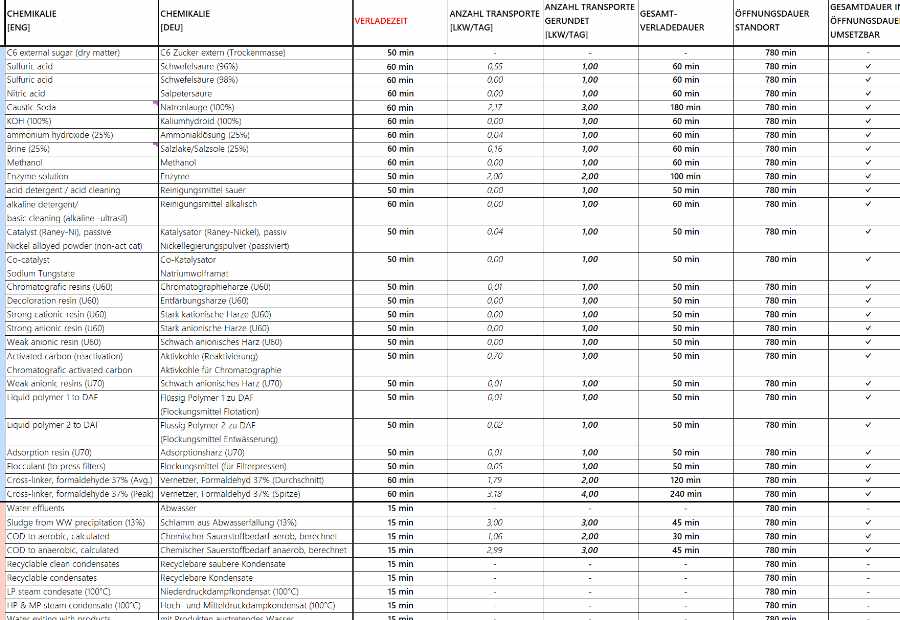
Material Analysis as the Basis for Logistics Planning
Raw materials, auxiliary materials, sidestreams and finished products were systematically structuredA key step was the structured recording of the materials used. For logistics planning, quantities, mass balances, transport-relevant properties, storage quantities and process-related requirements were brought together.
Materials with comparable properties were clustered into material groups. This allowed transport modes, intermediate storage demand, documentation obligations and specific requirements for handling, storage and collection to be systematically evaluated.
Transport Mode and Material Group Matrix
From material group to suitable transport and loading logicA transport mode and material group matrix was developed for the logistics assessment. It assigned suitable transport modes, loading processes, documentation requirements and relevant operational boundary conditions to the individual material groups.
On this basis, network analyses, route analyses, time slots, loading and unloading zones as well as required intermediate storage capacities could be derived in a transparent way. At the same time, impacts on operating hours, process requirements and site capacities were evaluated.
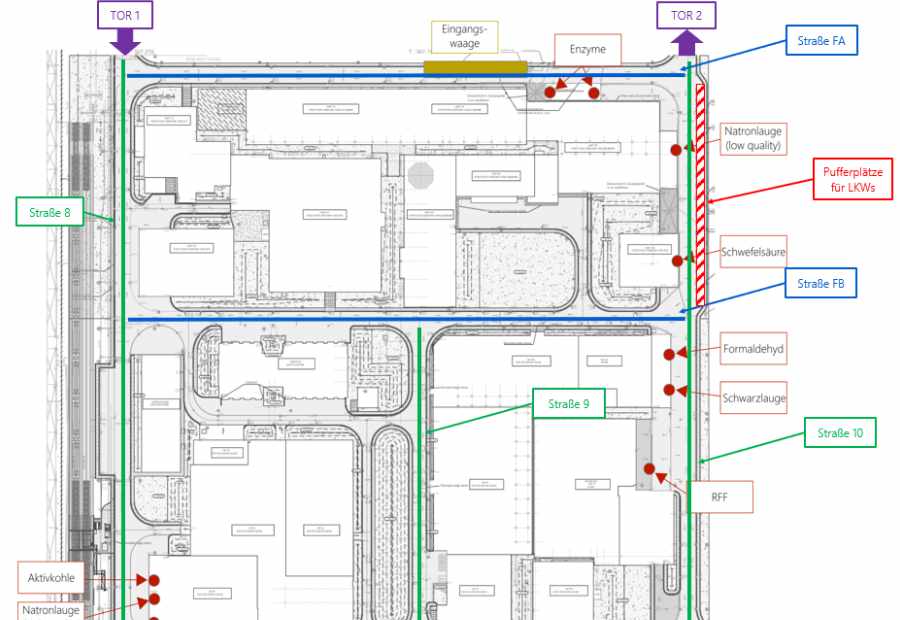
Methodology
The concept was developed step by step from current-state assessment, material analysis, logistics evaluation, capacity assessment and coordination with project stakeholders.
1. Assess the Site
Recording of the current situation, planned operation, loading points, scales, gates and operational workflows.
2. Form Material Groups
Listing, clustering and evaluation of materials based on quantities, properties, storage quantities and transport relevance.
3. Derive Logistics
Transport matrix, network analysis, routes, intermediate storage, space requirements and loading and unloading zones.
4. Check Infrastructure
Assessment of capacities, time slots, traffic areas, measuring systems, loading systems and site limits.
5. Evaluate Risks
Integration of immission control, noise protection, dangerous goods aspects, documentation obligations and approval-related issues.
6. Document Results
Preparation of results in interim and final presentations as well as digital compilation of documentation.
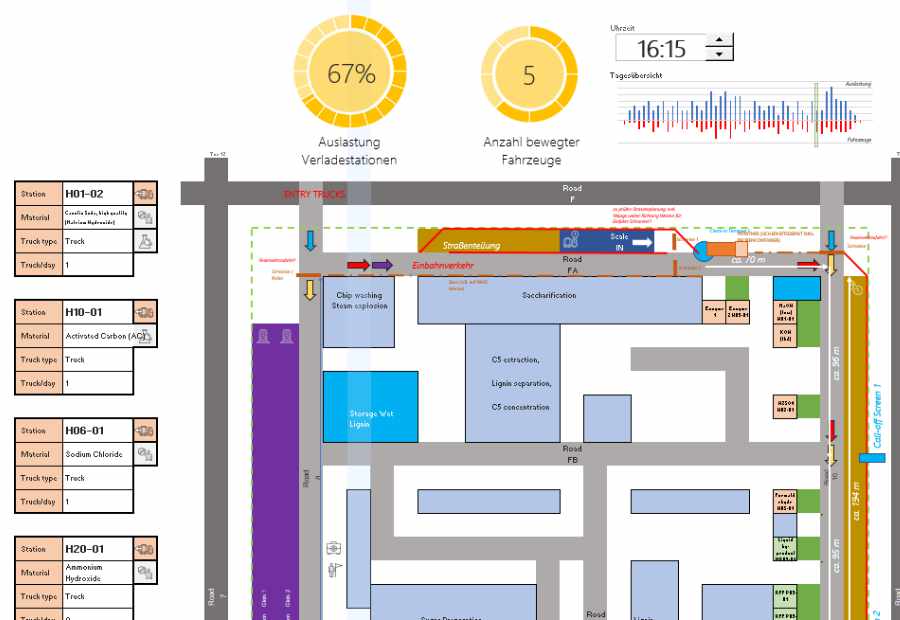
Site Logistics Between Efficiency and Approval Capability
Capacities, infrastructure, time slots and immission control had to be considered togetherThe technical challenge was to align the planned operational workflows with the actual site infrastructure. Loading points, gates, scales, waiting zones, routes, loading and unloading areas as well as intermediate storage areas had to be evaluated in such a way that low-disruption operation remains possible.
At the same time, the logistics concept had to work not only internally, but also take external requirements into account. These included noise and immission control aspects, capacity limits, material-specific requirements, documentation obligations and approval-related boundary conditions.